The Fort Worth Railroad Rescue Hero Was a Welsh Immigrant Nobody Remembers |
Morgan Jones was the man who saved Fort Worth in 1876, completing the final 26 miles of Texas and Pacific Railway track before a state deadline that would have killed the city. He laid more than a mile of track per day in brutal summer heat, finished on time, and then spent the rest of his life making sure almost no one knew his name. |
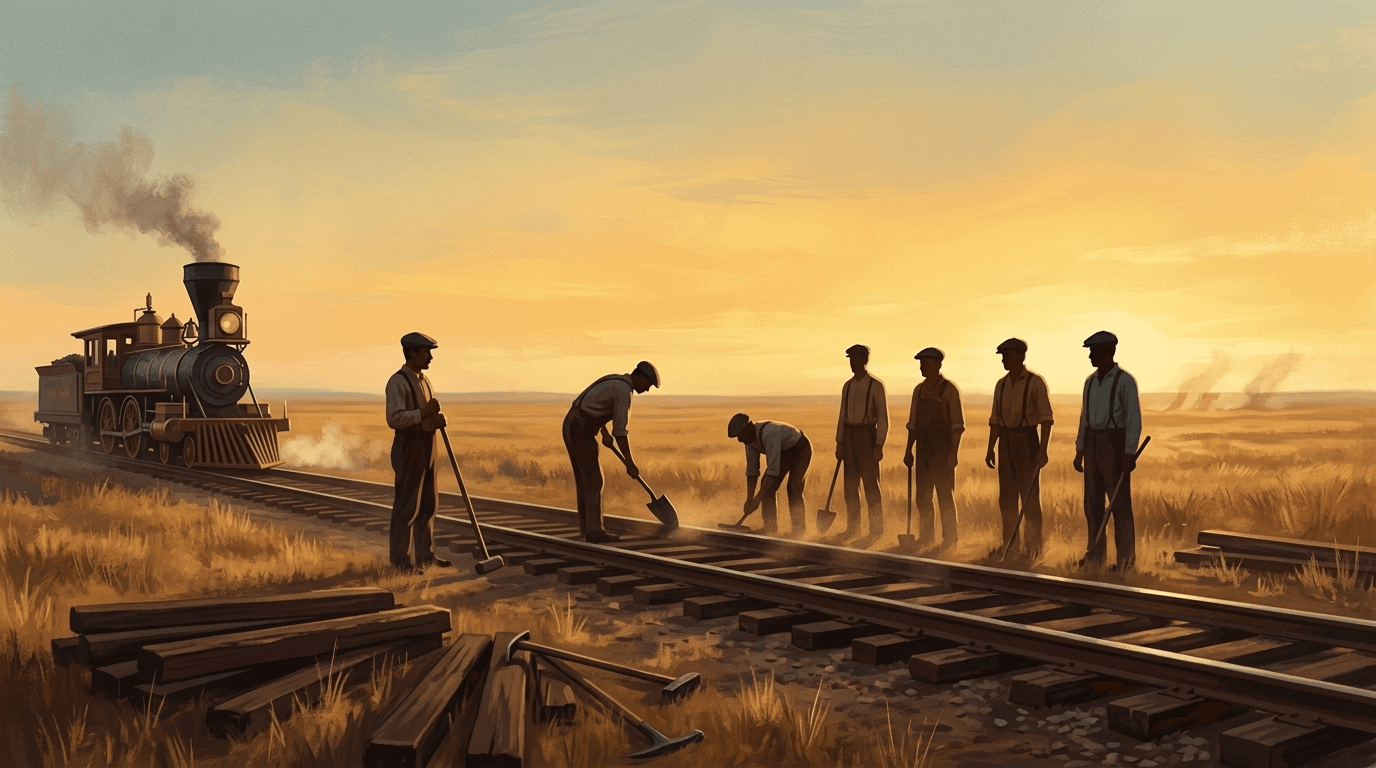
Fort Worth in 1876 was on borrowed time. The Texas Legislature had handed the Texas and Pacific Railway a charter with a hard deadline: get the railroad into town or lose the rights. The company had been trying for years and was running out of money and time. The city had fewer than 600 people. Businesses were closing. Families were leaving. Without that railroad, Fort Worth was going to become just another forgotten dot on a Texas map.
A City on the Verge of Disappearing
So the T&P went looking for someone who had already done the impossible once before.
They found Morgan Jones. He was a Welsh immigrant who had come to America and ended up working under Grenville Dodge, the superintendent who oversaw construction of the first transcontinental railroad. That is not a minor footnote. Dodge's transcontinental project was one of the largest engineering feats of the 19th century, crossing mountains, deserts, and open plains. Jones was part of that team. He knew how to build fast, how to keep crews moving, and how to finish what others had started.
When the T&P brought him in to complete the final 26 miles into Fort Worth, they were not hiring a local contractor. They were hiring a man who had already helped link the continent.
More Than a Mile a Day in July Heat
What Jones did next is the part Fort Worth should know better than it does. He drove the work at more than a mile of track per day. In July. In Texas. That is not a pace you maintain with a comfortable crew in mild weather. That is a pace you maintain when the deadline is real and the stakes are everything. He had help, too: Fort Worth residents, ordinary working people, left their jobs and grabbed shovels. They showed up because they knew what was on the line. Jones organized them and pushed the work forward day by day.
On July 19, 1876, the T&P locomotive rolled into Fort Worth on schedule.
Think about what that day meant for the people standing there. Fort Worth had been shrinking. The cattle drives gave the city its pulse, but without rail connection, that pulse was going to stop. The railroad meant cattle could ship by train. It meant merchants had supply lines. It meant settlers could come in numbers. The city went from fewer than 600 residents to a genuine commercial hub in the years that followed. The Cowtown identity, the Stockyards, the whole character of this place as the city where the West begins: none of that happens the way it did without a locomotive pulling in on July 19.
The Man Who Never Sought Credit
And almost none of that gets traced back to Morgan Jones.
That is the part that takes some sitting with. Jones spent his life avoiding photographs and interviews. He did not seek credit. He did not write memoirs. He did not apply for honors. After the T&P job was done, he kept building railroads across Texas, doing the same kind of work in one community after another, without making a name for himself in any of them. He was, by every account, a man who thought the work was the point, not the recognition.
For a city that celebrates its founders and civic leaders with statues and street names, that kind of quiet is remarkable. Lancaster Avenue, one of Fort Worth's most recognized addresses and the street where the historic T&P Station still stands at 221 W. Lancaster Avenue, carries the name of John L. Lancaster, the T&P president in 1929, decades after Jones laid the track. The station itself, that Art Deco landmark that has anchored downtown for nearly a century, came years after his work was done. He never got a street. He never got a building. He got the city.
That may actually be the more honest legacy. Streets and buildings get renamed. The act of saving a city is permanent.
The 1930-31 station that stands today was designed by architect Herman Paul Koeppe with chief engineer Preston M. Geren. The 1899 depot before it came from architect Otto H. Lang. Fort Worth has always known how to honor the architects and the civic leaders. Jones was neither. He was the man with the crew and the deadline, and he delivered.
What Jones represents is a kind of Fort Worth character that the city still recognizes even if it does not always name it. The willingness to take a hard job, show up without fanfare, work alongside the people around you, and get it done because it needs to be done. Those Fort Worth volunteers who left their jobs to grab shovels and help lay track had the same instinct. They did not wait for permission or a parade. They saw the problem and moved.
Fort Worth has built a lot on that foundation since July 19, 1876. The Stockyards. The Cultural District. Near Southside. Sundance Square. None of it is imaginable without the railroad, and the railroad getting there on time is not imaginable without a Welsh immigrant who learned his trade under Grenville Dodge and refused to let a deadline beat him.
He spent the rest of his long life building more railroads across Texas, one project after another, in the same quiet way. Find out more about Morgan Jones, Texas' Own Railroad Builder Pioneer, and what his work built at the T&P Station at 221 W. Lancaster Avenue, where the history of that arrival still lives in the bones of the building. |
18 Comments
Join the conversation
All this makes me think we focus too much on the high profile names and not the folks who do the actual work.
Let’s be real, without that train Fort Worth would just be another sleepy Texas town. Jones really saved it.
I wonder if any of his family still lives around here. Be neat to know if that legacy keeps going.
Makes me want to visit the station with a new appreciation. I’ll look at it differently now knowing this story.
Respect to the people who just saw a need and started working, no parade necessary. That’s the kind of grit I admire.
I didn’t know about Morgan Jones until now. Wish they taught more about people like him in school here.
They build big art deco train stations for execs but no marker for the guy who made it all happen? Come on city leaders.
The volunteers stepping up to help is what makes Fort Worth special. Folks still got that spirit today.
I walk by T&P Station all the time but never really thought about who actually got the tracks there. Good to know now.
Without the railroad, Fort Worth probably wouldn’t be the city we know. Crazy how one project changes everything.
The pace they set is insane. Over a mile a day in July? I barely make it to my car without sweating through my shirt.
My great-great grandfather worked for the railroads in Texas around that time. Makes me feel a connection reading this.
Anyone else wish they'd give a street or something to Jones? Seems overdue if you ask me.
Love stories about quiet people doing big things. He deserved more credit, honestly.
Always thought Lancaster Avenue was named for an early leader, not just a railroad president from much later. Funny how history gets lost.
Morgan Jones sounds like a real workhorse. Not many folks would take on a job like that and not want their name plastered everywhere.
It’s wild how few people used to live here. Under 600! Hard to imagine now with all the growth.
Never realized the city almost disappeared like that. Makes you appreciate Fort Worth even more!