
The Tarrant County Lawmaker Who Held On for Fifteen Days and Saved Fort Worth |
Most Fort Worth residents know the Panther City nickname. Fewer know that the city only exists as it does today because a sick man was carried into the Texas House chamber on a cot for fifteen consecutive days to prevent the legislature from adjourning before Fort Worth could finish laying its railroad. State Representative Nicholas Henry Darnell of Tarrant County is the reason this city had a future in 1876. |
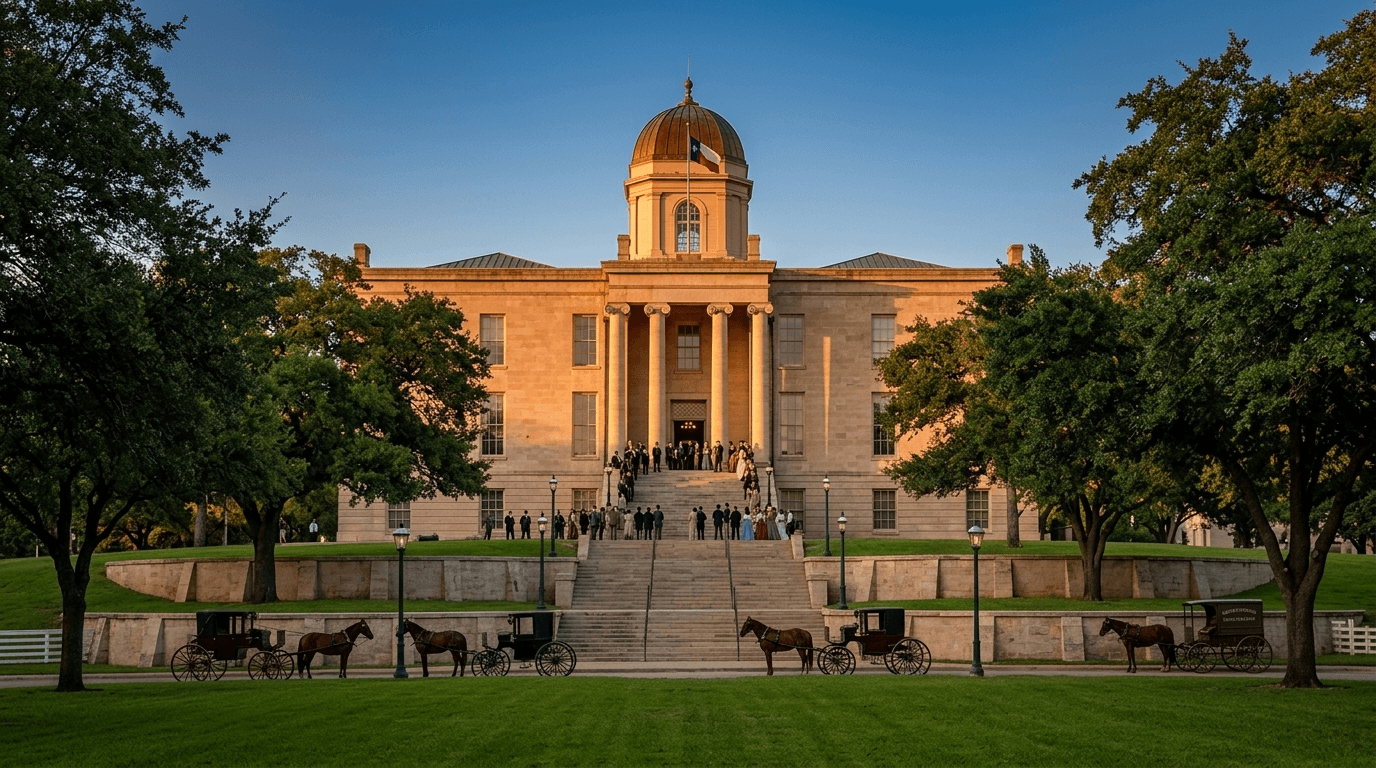
There is a version of this story that ends with Fort Worth disappearing from the map entirely. By 1876, that outcome was not hypothetical. The investment bank backing the Texas and Pacific Railway had failed and filed for bankruptcy in New York, leaving the railroad without money to complete its line. The Texas Legislature had promised the T&P 640 acres per mile of railroad laid between Dallas and Fort Worth, but without that land grant, the project was dead. And without the railroad, a city that had already shrunk from 3,000 residents down to about 600 in under a year had almost no reason to exist.
Fort Worth citizens did not wait for someone else to solve the problem. They formed a construction company on their own terms: the residents would build the road bed, the T&P would lay the rails. It was an extraordinary arrangement for an ordinary town, and it required something equally extraordinary in Austin to make it work.
Fifteen Days on a Cot
Historian Mike Nichols, author of Lost Fort Worth and the Hometown by Handlebar blog, described what happened in the Capitol: "As the House began to vote to adjourn, Darnell was ill. But each day for 15 days as the railroad got ever closer to Fort Worth, Darnell was carried into the House chamber on a cot to vote 'nay' to adjournment."
Nicholas Henry Darnell was Tarrant County's representative in the Texas House. He was sick. He was likely more comfortable in a bed than in the Capitol chamber. And yet, for fifteen days running, he was carried in on a cot and cast his vote against adjournment. Every day that vote held, Fort Worth had another day to lay track. Every day the legislature stayed in session, the land grant remained legally possible. One man's refusal to give up his seat, in the most literal sense, bought the time Fort Worth needed.
The Race on the Ground
The citizens' construction company on the ground was doing its own version of the same thing. Track was going down in a race against a legislative deadline, and the pressure was real enough that the final miles were laid with minimal proper bedding, just enough rail on just enough dirt to cross the finish line. The craft could be corrected later. The deadline could not.
What makes this the Austin side of the Panther City story is that it runs counter to the comfortable narrative that Fort Worth built itself entirely by its own hands. It did not. It built itself by its own hands and by one lawmaker from Tarrant County who understood that the survival of his home city depended on him staying in that chamber until the work was done. That kind of representation, specific, stubborn, and consequential, is rarer than it sounds.
For Fort Worth residents who have watched a hundred years of complicated feelings about what state government does or does not do for North Texas, this story is worth holding onto. In July 1876, Austin delivered. One representative made sure of it, cot and all.
The Texas State Capitol at 1100 Congress Avenue in Austin is where those fifteen votes were cast. The next time you are in Austin, stop by and consider what that chamber meant to Fort Worth 150 years ago this month.
Fort Worth does not have a lot of monuments to the people who kept it alive in its worst year. Nicholas Henry Darnell does not have a statue on the courthouse lawn. Most Fort Worthians have never heard his name. But the next time you drive past the Stockyards, or the Cultural District, or the T&P station on Throckmorton Street, the city you are looking at is the city he refused to let the legislature abandon. That is worth knowing. |
14 Comments
Join the conversation
Kinda makes you wonder what little decisions today will matter 150 years from now. History is strange!
I always thought Panther City was just a nickname, didn’t know there was this whole backstory to it.
Funny how nobody ever mentions the sick guy on a cot in regular tours lol. Time to update the storybooks!
visit the Capitol room? adding that to my summer list honestly. Neat tie-in with our city’s birthday.
Not sure anyone in Austin would fight that hard for FW today but cool reminder that they did once.
Stories like this are why I love living here. Folks coming together to lay rail by torchlight? Heroes.
My granddad used to talk about the railroad like it was a miracle. Now I get why!
15 days is a long time to drag out a session when so much is at stake. Makes politics seem a little more epic!
Legend says Fort Worth’s got stubborn pride, guess it started earlier than I thought!
How did Fort Worth drop from 3,000 to 600? Never realized things got THAT bad. We really bounced back.
Respect to Darnell. Being carried in every day? That’s dedication. Wonder if anyone would do that now.
I never knew so much history happened in Austin for Fort Worth. Makes me want to go visit the Capitol now!
This needs to be taught in FW schools. The folks laying track at night – that’s some serious grit.
Had no idea the city almost missed out on the railroad! Wild to think it hung on Darnell showing up so sick.