How Fort Worth’s First Train Changed Cowtown in 1876 |
A race against a legislative deadline brought the Texas & Pacific Railway to Fort Worth on July 19, 1876. Here is what happened, who helped, and where to explore the railroad legacy today. |
Before Fort Worth became a major railroad hub, it faced an uncertain future. In the mid-1870s, the city needed a dependable connection to markets beyond North Texas. The Texas & Pacific Railway offered that chance, but the final miles into town were anything but assured.
On July 19, 1876, the first Texas & Pacific train finally reached Fort Worth. The arrival became a turning point for local commerce and for a community whose residents had helped make the connection possible. The story is less about one heroic locomotive than about the people who refused to let the tracks stop short of town.
Why the railroad mattered
Fort Worth grew as a frontier settlement and cattle-trail stop, but economic setbacks threatened its prospects. Railroads offered faster connections for passengers, freight and livestock. As the Texas State Historical Association explains, the arrival of the T&P in 1876 revived the city’s economy and helped establish its future as a regional rail center.
Getting the line completed was difficult. A financial crisis had interrupted railway construction, and the company faced a deadline connected to its state land subsidy. If the track failed to reach Fort Worth in time, an important part of the project’s financial support was at risk. Local residents decided they could not afford to wait.
Fort Worth residents helped build the way in
A group of citizens organized the Tarrant County Construction Company to help prepare the route. According to the City of Fort Worth’s history, people subscribed money, labor, materials and supplies. Major K. M. Van Zandt became president of the company, and work began in fall 1875.
The land contribution was a shared effort. City history identifies Van Zandt, E. M. Daggett, Thomas J. Jennings and H. G. Hendricks as contributors of a combined 320 acres to the railway. It was a collective commitment by several Fort Worth leaders to secure the rail connection their city needed.
Morgan Jones and the last-minute race
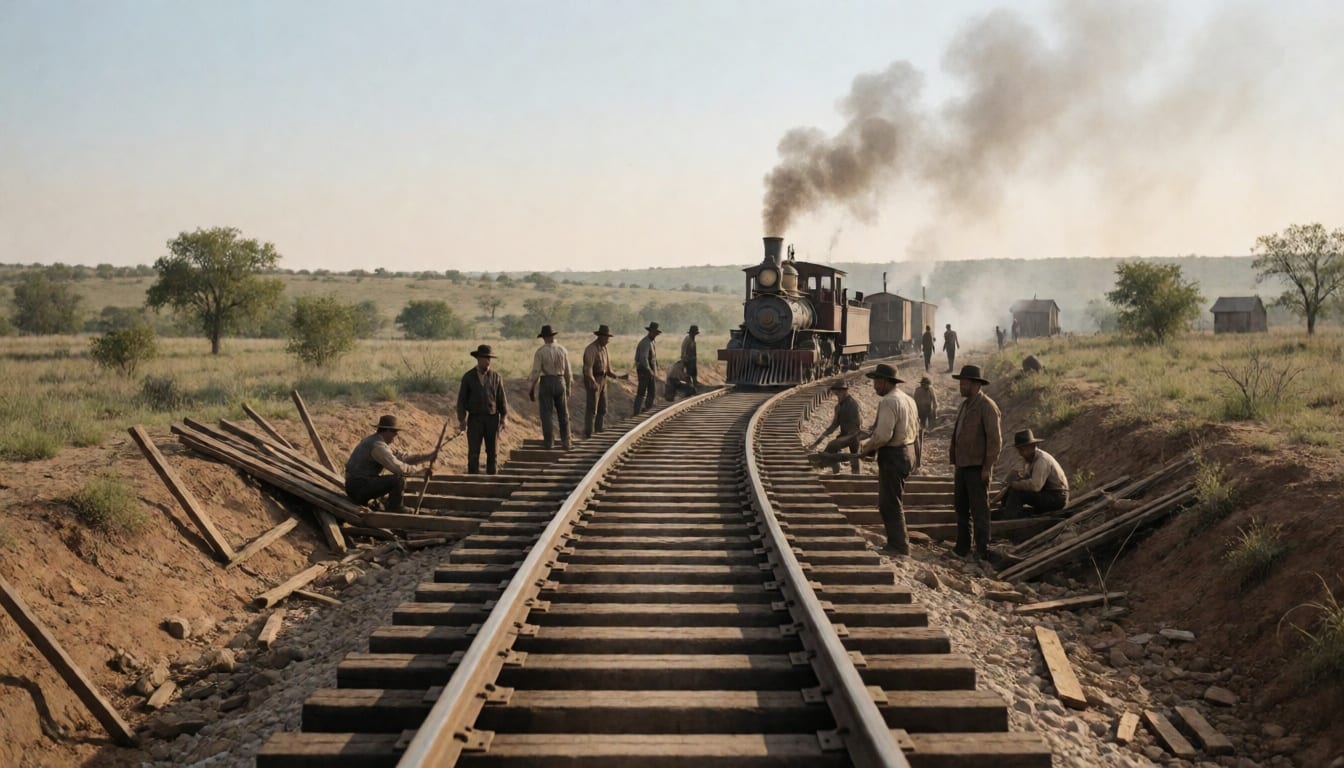
Welsh-born railroad contractor Morgan Jones supervised the final push. The City of Fort Worth describes an extraordinary effort, with crews working under torchlight and Jones getting only brief periods of sleep. In an unusual attempt to meet the deadline, one account says the city council extended the city limits a quarter mile east, reducing how far the railway had to reach.
The final track was improvised in places. At Sycamore Creek, workers used stacked railroad ties to support the line, while portions beyond were laid on the ground rather than on a completed railbed. The details help explain the urgency without pretending it was a tidy construction project.
The Texas State Historical Association confirms that the railway reached Fort Worth on July 19, 1876. People traveled from surrounding communities to see it, some encountering a locomotive for the first time. The completion signaled that Fort Worth had secured a link to a much wider transportation network.
From cattle-trail town to rail center
The economic effects went beyond a single celebration. Fort Worth became a stronger shipping point for livestock and a destination for commercial activity. More railroads entered the city in the years that followed. The city’s heritage as Cowtown rests partly on the practical relationship between cattle, merchants and rail transportation.
That does not mean every later Fort Worth development can be traced to one train. The growth of the Stockyards, neighborhoods and industries involved many later decisions. But July 19, 1876 remains a useful milestone because it marks a clear change in the city’s ability to move people and goods.
What you can still see in Fort Worth
There is an important distinction between the first train and the historic station visitors recognize today. The present Texas & Pacific Passenger Terminal, at 1600 Throckmorton Street near Lancaster Avenue, was built in 1931. It is an Art Deco landmark, not the original 1876 depot. The Texas Historical Commission records a historical marker for the terminal near Lancaster and Throckmorton.
That later building is still a worthwhile place to appreciate Fort Worth’s railroad history, especially for its architecture and its connection to later passenger service. But it should not be described as the spot where the first train pulled in or where 1876 spectators stood. The railroad’s early stations were different structures, and the first depot was a modest wooden building.
A resident interested in the story can begin with the historical marker and the exterior of the later T&P terminal, then read the City of Fort Worth’s history and the Texas Historical Commission’s marker record. Confirm current building access and transit information before planning an interior visit. Those sources offer a more accurate way to connect the city’s modern rail landmarks to their nineteenth-century origins.
Why the date still matters
Fort Worth marked the 150th anniversary of its first train in July 2026, but the significance is not limited to an anniversary month. The episode offers a durable local lesson about civic effort, transportation and the way a town’s future can hinge on whether a major connection actually arrives.
For Fort Worth residents today, it is a reason to look differently at the tracks and railway buildings south of downtown. The train of 1876 is gone, and the terminal people see today came much later. The determination that brought the railway to Cowtown is still part of the city’s story.
Sources and further reading
|
0 Comments
Join the conversation
Be the first to comment
Share your thoughts above.